Basic Level

The Scissor Stance

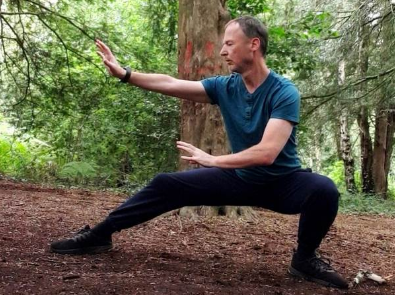
The scissor stance (also known as the crossover stance) is one of the most useful stances in kung fu. It is often not the fastest or strongest fighter that wins the day but the one with the best footwork. Good footwork gets you quickly out of danger and puts you in a position where you can move from a position of strength into one where your opponent is weak. The […]
Read More

The Tiger Stance

The tiger stance is another great stance to develop leg strength. Most of the weight is on the back leg so it enables you to move forward with power. It is also great practice to move from a tiger stance forward into a dragon stance and back to tiger. The tiger stance is one of the most challenging although it looks easy. It stretches some muscles while holding others in […]

Read More

The Dragon Stance

The dragon stance (sometimes called the forward stance or bow and arrow stance) is one of the most fundamental stances in the Chinese arts. It is the main stance used when receiving power from the front or delivering power to the front. If someone tries to push you backwards you just place one leg behind you and root down and they won’t be able to move you. Below is a […]

Read More

The Flying Crane

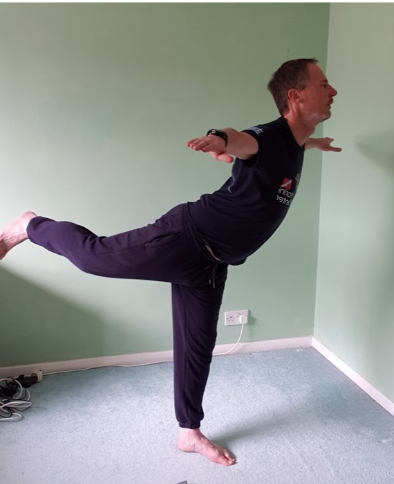
Back strength is a crucial component of tai chi and kung fu as it is of life. Most people have weak backs as we don’t use them for most of the day as we are resting them on the back of chairs. Even while standing the back muscles are only weakly engaged and cannot compete with the gradual shortening of the front of the body. The flying crane exercise strengthens […]

Read More

The Horse Stance

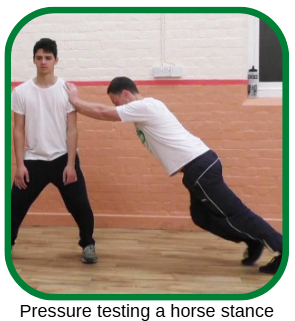
Whoever you are don’t neglect horse stance training. The horse stance is the most important skill new beginners should focus on. In some traditional schools in China new beginners would do nothing else but the horse stance for months on end until they could stand in a deep stance for half an hour without moving! We don’t need to go that far but never forget your horse stance is the […]

Read More

Side to Sides

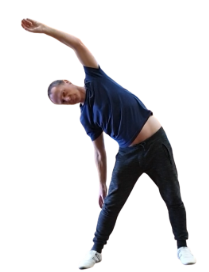
This is a my favourite exercise for dropping tension out of your shoulders and neck. It’s simple to do. Just remember to do it slowly and smoothly and let gravity do the work. Side to Sides Stand with your feet wider than shoulder width apart with legs straight and raise your arms out to the sides. Moving from the centre slowly lean over to the left sticking your right hip […]

Read More

All Parts Move

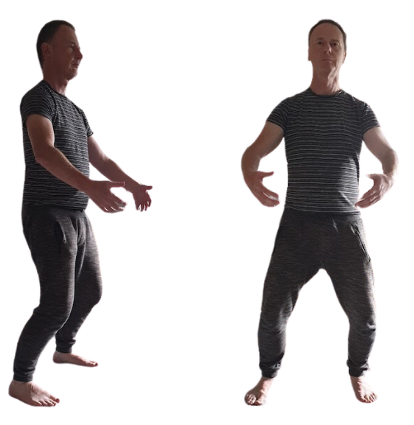
In tai chi no part of your body moves on it’s own. Every part is supported by the whole. Most of the movements you do in life only involve a small part of your body. It’s very rare that any movement involves all of your body unless you’re trying to lift or move a heavy object. Even then the body is uncoordinated and the parts don’t work together very well. […]

Read More

Expand Outwards

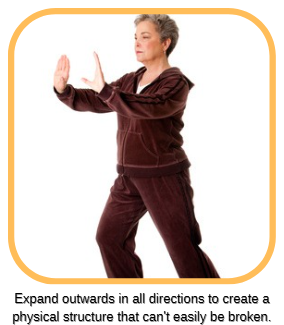
Whenever you feel any kind of fear, stress, anxiety or anything of the kind your body instinctively contracts inwards. This is a natural reaction that tenses your muscles ready for fight or flight. It’s like a tortoise withdrawing into its shell at the first hint of danger. The trouble is that, unlike the tortoise, you rarely get a chance to come back out of your shell and relax again afterwards. […]

Read More

Form Second Section Video

As with the first section work on each movement individually first. Then put them together. You’ll notice that the moves after embrace tiger, return to mountain are the same as for the first section – rollback and press, push and single whip. You should already be becoming familiar with these important moves. Both the videos below begin with single whip which was the last move of the first section. https://youtu.be/UhGiY_74zfo… […]

Read More

Form First Section Video

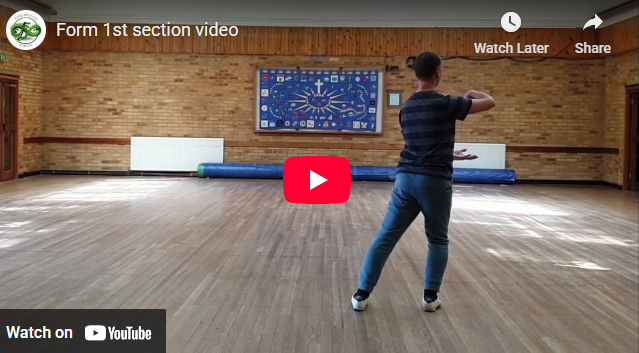
This video shows you the first section of the form up to the first single whip from two different angles. Once you’ve learned each of the movements separately use this video to see how to join them together. Then work on incorporating the 4 key qualities of movement and breathing. https://youtu.be/90yOWUZmioI… Sorry but to access this course or article you will need a relevant subscription. CLICK HERE to get your […]

Read More

Skip to toolbar