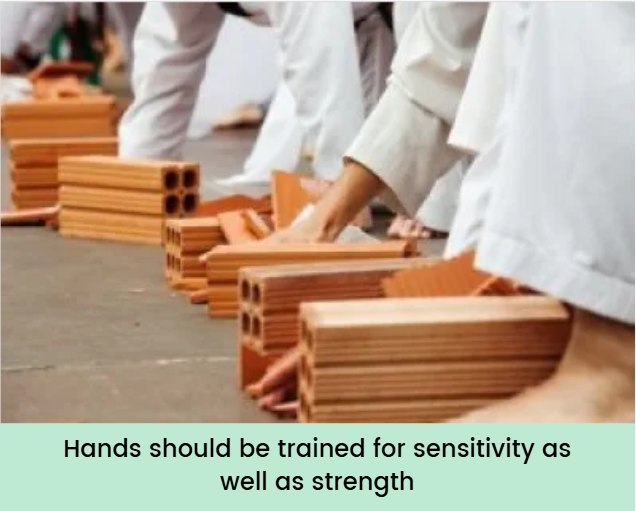
Ever since we first learned to stand and walk on two legs humans have used their hands to reach out and connect with the world. Our hands are highly sensitive and very dexterous and it’s important that we look after them. Too many people end up in their old age with hands that can hardly move and lack the power and dexterity of their youth. They do this through unbalanced and reckless hand conditioning training.
‘Boards don’t fight back’
The above is a classic line from Bruce Lee’s film ‘Enter The Dragon’ but it’s as true today as it was then. A lot of people spend a lot of time developing the ability to break inanimate objects. But I’m afraid this has little to do with actual combat skill and it’s more in the line of a circus trick that is often used as good marketing for the school.

Avoid breaking practices
Popular though breaking practices are I strongly recommend that you avoid them and avoid schools that practice and teach them.
The most important reason to avoid breaking practices is the short and long term damage to the hands and wrists. These include bone deformations, callouses, hairline fractures, arthritis and so on. Any practice that has little functional value yet can damage your body severely should have no place in your training schedule.
What is this training for? Supposedly to develop a ‘killer’ strike that will stop the fight dead. But suppose you were to use your ‘killer strike’ in real combat. One of two things would happen. Either it would be blocked or would miss its target – all that training wasted, or worse it could hit its target and do far more damage than you intended as you have never hit a person with this force before.
There is a genuine risk that if your big power strike was used successfully in actual combat it could seriously injure or even kill someone (and yes this has happened). Power breakers aren’t used to slowing down or controlling the force of their strike – they need maximum speed on impact to smash boards or bricks. This lack of control goes against the philosophy of most respected martial arts.
People are also not built like boards or bricks – we are essentially big bags of water and behave like it when struck hard. The training is totally unrealistic.

Board breaking – a very dangerous pursuit
For real martial artists who shun power breaking you need to increase both the sensitivity and the power of your hands. Of these two qualities sensitivity is by far the most important. Hands don’t need to be powerful unless you are intent on gripping your opponent with force. However, they do need to be able to transfer the force coming through the rest of the body and arm through the hand and into the opponent without damaging your hands.
Iron Palm training
Some of you may have heard of the practice called Iron Palm. Iron Palm training when done properly and with the use of the correct herbs etc can make your hands very strong without loss of sensitivity or damage. There are two main versions of iron palm and you can use either or both.
External iron palm.
The external way involves gradually striking your hand into more and more solid surfaces eg sand, gravel etc. When done badly you are likely to cause harm to your hands and lose dexterity and sensitivity as well as causing you unremitting pain. External iron palm training aims to turn your hand into a hammer that will absorb much of the impact force itself and without this conditioning training the hand would break.
To make iron palm effective it must be trained very gradually so as not to destroy the nerve endings or put intolerable strains on the bones and soft tissues of the hand or body.
There are herbs available to help the hand recover between practices, particularly the legendary dit da jow. However, unless you are a herbalist yourself you won’t know what’s been put into this and there is a lot of fake dit da jow being sold for high prices which is of little, if any, use.
Internal iron palm
Internal iron palm involves contracting your breath into the palm to achieve the same effect but without loss of sensitivity or incurring such damage to the palms. It takes a lot longer, some say around three times as long to get the same effect. Also it is important that you have been taught good basic breathing practices first.
Internal iron palm can be mixed with external to give speed up the process and lessen the damage. However, if you intend this type of training do be aware that both have serious risks attached and make sure that you find a master who has undergone such training without severe damage to his hands.
While serious Iron Palm training is not recommended without qualified instruction there are some things you can do to strengthen your hands:
- Push ups can be done on the knuckles however, these must be done on a soft surface ie carpet or grass. No wooden or concrete floors which will damage the knuckles.
- Push ups can also be done on the fingertips or the backs of the hands. This is not as difficult as it sounds and can be done on any surface.
- Towel wringing – doesn’t have to be a towel, a tshirt will do just as well. Twist it as if you were wringing water out of it. Then change direction ie left hand up instead of down. This is great for all forearm muscles and grip strength.
- Any kind of weapons training will help develop the hands and grip strength. This, in fact, is the preferred way in most martial arts. The weapons teach you to remain relaxed and sensitive in the hands for moving the weapon yet be able to grip hard when necessary to produce the whip-like force through the body and into the weapon that higher levels of weapons training require. (more on this below)


Fingertip press-ups. Build up to these gradually.
Soft hands = fast hands
Hands tend to hold onto a lot of tension so it’s important to learn to keep them loose and relaxed. Remember – the more relaxed they are the more sensitive they are which helps develop lightning reflexes. This means that they will feel the movements of your opponent quickly and accurately so that you can adapt and respond appropriately. Too much tension will prevent you from getting good feedback or from being able to react in time. As long as he is maintaining hand contact a good martial artist shouldn’t need to look at his opponent but should be able to use the feedback from the touch of his hands to know exactly what the opponent is doing. This leads to increased sensitivity and speedier reflexes. Your countering movements will be faster and more accurate and you can feel the gaps in his defence.
Fighting without looking.
Learning to feel the changes in your opponent and respond to your sense of touch ie fighting without looking is a great skill to develop. You will find that your sense of touch can become faster and more accurate than your eyes. It doesn’t take much practice for a person to be able to strike faster than you can see. But, if you’re in contact with the strike as it comes in then you can feel and react to it much faster than you could if you were relying on your eyes to see the incoming punch.
There are three other reasons why learning to fight without looking can be important.
- Many people use facial expressions, staring eyes and the tone of their voice to instill fear or anger in their victims. By not looking directly at your assailant you are less likely to be ‘hypnotised’ or psyched out like a mouse with a cobra.
- Rarely does a person start a fight on his own these days. Usually he will be part of a group. Being able to make contact then control your assailant without looking at him means you are free to look around you, assess the situation and environment, see who are his allies and who are your own, find the exits, find objects that could help you or help your assailant etc.
- Not looking at your assailant signifies that he is beneath your contempt and not worth bothering with. This is psychologically damaging to them and likely to arouse their own fear and anger – exactly what they were trying to do to you.
Wow. How do I gain this sensitivity?
Sensitivity comes through relaxation. You can gain sensitivity in your hands simply by giving them your attention:

- Focus your attention on the tips of your fingers. Feel them start to tingle.
- Brush your fingers and hands lightly over different surfaces and see how much feedback you can get both with eyes open and closed.
- Close your eyes and explore the immediate surroundings with your hands. Only by repeatedly bringing your attention into your hands can sensitivity be increased. Regular practice will sharpen your reflexes and deepen your awareness of your surroundings.
- Learn to use only as much force as is necessary to manipulate the world around you. For example learn to hold your knife and fork more lightly, as if they were very fragile. Don’t grip your steering wheel hard but lightly and make the movements from the elbows rather than hands. This will also take some of the tension out of the shoulders.
- Iron palm training can be useful if it is taught properly by a qualified person who still has full dexterity and sensitivity in his hands as well as iron like power.
- Traditionally hand sensitivity was increased by push hands type drills in class. Push hands training enables you to directly read and react to the movements of another person.
Weapons for gripping power.
In many traditional schools weapons were a key part of their training. Apart from their obvious use in defense they also helped develop hand conditioning properly for hand to hand combat. The advantages included:
- Regular practice increased the strength and flexibility of the hands, wrists and forearms.
- Training taught the practitioner how to manipulate the weapon efficiently, when to grip hard, when to let go, when to apply force and when to apply no force. The use of the weapon closely mirrors the use of the hands in actual combat.
- Two handed weapons, particularly the staff, would teach students to use their hands as a team.
- Regular training would help prevent the common beginners mistake of gripping too hard and not being able to unfreeze that grip. This could be dangerous in combat if you weren’t able to let go of your attacker to block or counter attack. Regular weapons training loosens the grip without sacrificing power and teaches you to grab and let go at will.
- The use of weapons also helped to focus the power along the weapon to the tip. This trained the practitioner to focus their locks into the arms of an opponent to take control of an elbow or shoulder at will and with virtually no effort. Proper use and positioning of the hands made this highly effective.
When it comes to hand conditioning you need to look after your hands, develop their sensitivity and aliveness but also remember that they are at the end of a chain of muscles and joints and it’s no good having strong yet sensitive hands if the rest of your body is locked with tension. However, release of tension in the hands will greatly aid relaxation in the arms and the shoulders. Practice touching and sensing and see just how relaxed, fast and sensitive you can become. Then, when needed they too can become weapons of steel before relaxing back into softness again.