The loss of function in kung fu forms
Forms training is a backbone of most traditional kung fu and tai chi schools but why is this so and what is actually being taught?
This article puts forms under the microscope to look at the 3 main types of forms training and how forms training is gradually degenerating from being the most efficient way to learn and develop real, adaptable fighting skills into competitive, stylised dance movements.
.

A stylised form being practised in China
A kung fu form is a series of movements that is designed to exercise the body in a wide variety of ways. There are many kinds of forms – hand forms, weapon forms, animal forms, kicking forms etc and these range from stylised forms through partly functional to fully functional forms. This article examines the differences.
Stylised forms
A stylised form is a series of movements of stylised fighting skills. The form is judged on how it looks and how precisely it is performed. The form is taught exactly the same way every time and gradually the practitioner is able to perform the movements with more grace and skill, going lower in the stances, becoming more flexible in the kicks and so on.
These forms are common in wushu and many tai chi schools and, indeed many kung fu forms are of this type. If the form you are learning is being done the same way every time, if you are being judged on the way it looks rather than on how it can be applied, if you are not being shown any fighting applications or being given any chance at partner practice to see how it works then it is a stylised form.
There are many championships where people compete to see who can perform the hardest forms to the highest level.
These forms are common simply because they look good. But they contain no instruction on how to adapt the movements or how to use the skills under real life situations. They can be taught in a regimented way the same way to everyone and each person can be judged on how precisely it is performed.
In China these stylised forms were often taught to children to develop strong stances, joint flexibility, fluidity of movement and so on. Then as they became older the forms would change to become fully functional. Many kung fu schools in the West are actually teaching adults forms that were designed for children. If a form is overly flashy and clearly designed to stretch and strengthen the body yet lacks even basic functionality then it’s a child’s form.
Partly functional forms
With partly functional forms the teacher will know some applications for the form but not the full knowledge of how every single movement works and how to adapt it to suit changing circumstances.
I’m constantly amazed at how many students I see who have learned forms elsewhere but have little or no idea how to use them. A partly functional form could be anything from knowing just one or two applications to knowing the main applications for each movement. However, it’s unlikely they will also know the inner moves and how to adapt them. If your teacher only knows one application per movement then it’s a partly functional form.
Each movement of a fully functional form has many ways in which it could be applied, not just one.

ancient kung fu forms training
Partly functional forms, like stylised forms, tend to be done much the same way every time. They lack the complete adaptability of fully functional forms.
Fully functional forms
Functional forms don’t look anywhere near as beautiful as stylised forms – good kung fu is not supposed to be pretty, however, they do still contain obvious grace, balance and power. The difference is that every single movement, indeed the smallest aspect of every movement is functional.
The teacher knows every part of the movements inside out and is able to adapt and apply every single movement to a range of real fighting applications. He also knows, and is able to teach the students how to make each movement as powerful and efficient as it can be under pressurised circumstances. See the article on Kung Fu MAP
The other main difference is that the functional form is completely changeable and adaptable. Every aspect of it: the depth of the stances, the position of the hands, the size and direction of the circular arm movements, the direction of the stepping movements, which stances are being used and when etc are all fluid and changeable.
Only by being completely adaptable to the constant changes that take place in combat can any form be of use in real combat.
A functional form that is truly ‘alive’ will almost never be performed in the same way twice. It becomes a way of expressing yourself through your body, your movements and your art – indeed it is what puts the word art into martial arts.
There is no ‘right way’ to do a functional form as it depends on the circumstances. Just as there is no ‘right way’ to paint a tree. There are, however, many wrong ways. These will be the ways where the body is being used ineffectively or the technique being applied doesn’t fit with what the opponent is doing. This ability to be able to read your opponent and adapt your techniques accordingly – to be able to express yourself through your movements, prevents your martial arts from becoming too rigid which would mean you’ve lost the art in your art form. By constantly changing the way that you perform your movements during solo practice you remain constantly open to change and the possibility of adaptability.
Why is adaptability so hugely important?
When you perform any movement on any resisting opponent you have no idea how that opponent is going to react. They may fall to the floor, they may stand up and resist fiercely, they may step forward on a different leg than you were expecting, they may attack with a different arm or leg etc. If you aren’t able to adapt your movement skills to the change and are stuck doing the same moves the same way every time then you will lose. Every movement of a good, functional form should be doing the following:

- Attacking the opponents position in the most efficient way
- Protecting your body from attack not just from your opponent but as far as possible from other directions as well through continuous twisting movements that keep you aware of movement from any direction
- Doing movements that limit what your opponent is able to do next so that you can predict their likely next moves and already be in a position to take advantage of them
- Keeping you constantly alert and adaptable to how your opponent is reacting to your technique so that, no matter what the opponent does, you can follow them, see and feel the weaknesses in their movements and exploit them ruthlessly.
- Training your body to move as one unit in the most efficient and powerful ways possible
- Teaching you an encyclopedic knowledge of techniques that can be applied through the movements of the forms. Any movement of the form could easily have ten or more different ways of applying it. Through learning this knowledge you learn which technique to attempt at any moment depending on your position relative to that of your opponent.
- Most importantly, teaching you to adapt the skills you have to the way your opponent moves and reacts and to the constraints of the environment
Our first combat form is the Leaping Tiger. This is a truly functional and adaptable form with a wide range of applications of the movements.
Forms as a learning aid
Point 6 above is another aspect of forms training that is often overlooked – that forms were the main way of enabling students to memorise a wide variety of techniques.
Learning a martial art is like learning a new language. You don’t start at the letter a and work through the alphabet. You start by talking in simple sentences and build them up to tell stories. Good forms have been used for centuries to teach a wide variety of martial skills.
It’s just like learning to converse in a new language – your opponent makes a movement, you see it, interpret it and come back with an appropriate reply. Your reply is one that allows only a limited set of responses from your opponent and you learn how to reply to each of those responses. If they respond in an unexpected way your form is adaptable enough to cope without leaving you hesitating and getting hit while you think of an appropriate response.
Your techniques are the words of the sentence. The principles of effective movement are the letters that make up the words. There are only so many principles but without them your words will have no impact. The art lies in choosing the right words for the occasion while under supreme pressure.
Where did the function go?
It is worth saying that most stylised forms used to be fully functional but for various reasons including political interference, wars, not allowing outsiders the secrets that keeps their clan alive etc. the masters of old kept hidden the secrets of how to use their form movements for fighting. Instead they developed their forms into ones that were good exercise for the body but had little, if any, practical applications.
These new stylised forms enabled them to maintain their movement skills but without overtly displaying the functional combat skills hidden within them. Hence only the master and his most senior students would be able to interpret the form and be able to fully use all its applications. It takes a lot longer to learn and master forms that are adaptable. You learn the basic movements which are like a skeleton and then you learn to adapt it endlessly depending on how your opponent reacts to it. This ability to be sensitive to your opponents actions and constantly be adapting your form movements to it takes time and experience.
It is much easier to teach somebody a set series of movements that doesn’t change. This is the main reason why set forms (stylised or only partly functional) are often taught in large schools. It is much easier for a small school with a small number of students to teach a fluid, adaptable form than for a large school which probably has a more rigid syllabus and would find it far more difficult to teach and grade such adaptive forms.
Many modern martial artists denigrate the teaching of forms (the most famous critic being Bruce Lee). They have no place in the real world they say. They lack realism, they aren’t tested against an opposing partner, they are too fancy, during sparring practice everyone abandons the forms and just kicks and punches – they just don’t work in the ring or on the street. These detractors are absolutely right as long as they’re talking about stylised forms. It is may well be only stylised forms that these detractors will have seen because they are far more common than fully functional ones.
It is difficult to show the power and effect of fully functional forms as they don’t look too good when done on their own and even experienced martial artists wouldn’t see most of the applications hidden within them. You really need to experience them first hand. These forms tend to have one main aim in mind and that is to put the opponent at a major disadvantage right from the start and deny them the ability to counter successfully while attacking from a bewildering range of directions and forms of attack.
The number of teachers who are currently teaching good fully functional forms is decreasing
Forms teaching is becoming increasingly stylised and that is the main reason why, I believe good kung fu is dying out. When the teachers have lost the inner meanings and applications of their forms it is very difficult for them to be found again.
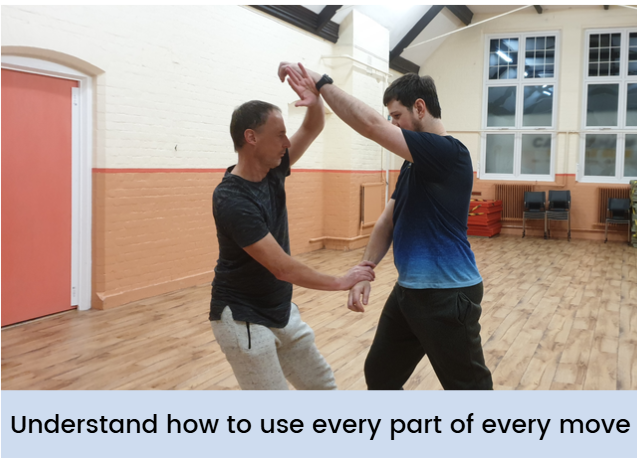
Without the knowledge of how to use the movements properly, the way the movements will be performed will drift further and further away from being functional and will be focused on looking aesthetically pleasing instead. It is inevitable that if something has no function that it be made to look beautiful instead.
In the Jade Dragon school, which is a small school, all our forms are fully functional and will always remain that way- indeed I often look at form movements that students have learned in other schools and show them how to make those movements functional. The most common phrase I hear is “why did nobody teach me this before?” Why indeed. Hopefully this article may give you some of those answers.