Most combat sports and martial arts use punches but they don’t always fully understand how to get the best out of this useful weapon in their armoury. Read on to discover the biomechanics of the punch and find out how, with a few small changes you can dramatically and instantly increase the impact power of your punch. This is the lowdown on the basics of punching.
There are many kinds of punches the most well known being the ones that come from the field of boxing: the jab, the hook and the uppercut are good examples. Different punches come from different directions and are produced in different ways using different muscles. Most beginners punch very inefficiently. They are slow, lack power and end up off balance and vulnerable to counter attacks.


A chain punch keeps the centre protected from attack
What is a Good Punch?
A good punch has the following characteristics:
- The body is rooted at the point of impact
- There is no excess tension anywhere in the hand, arm or body
- The punch finishes in a balanced and rooted position
- The fist is formed correctly
The above points apply equally to all punches. However, here we will also differentiate between punches that are done with power as opposed to punches that are done with speed.

To attain speed you must sacrifice power, to attain true power you must sacrifice speed.
Your fastest punch will never be your most powerful just as your most powerful punch will never be your fastest. It is easier to punch with speed than with power. Punching with real speed merely involves releasing as much tension as possible as any excess tension holds you back and slows you down.
Many people assume that to punch with power they need to build up their muscles with a lot of weight training. Let me make it clear now that although weight training does have its uses in physical development it has no role to play in punching power, in fact there is a good chance that it will actually make your punches weaker.
Leave the weights at the gym
Contrary to popular opinion weight training doesn’t make your punches stronger, in fact, it may even weaken them. I’m afraid it’s true. When you are weight training you are using exercises that develop each part of your body at a time. You learn to isolate and disconnect each part of the body separately to train it. This is the opposite of what good punching requires.
To punch with real power you need to coordinate your whole body together. In this way your legs, hips, waist, back, chest, shoulders and arms are all working as a team. They become, in effect, one large muscle and that one large connected muscle will always be stronger than the man who over develops specific muscles but can’t connect them together to punch properly.
Weight training also strengthens the muscles that oppose the direction of the punch so unless you have specifically trained to relax those muscles your weights will put the brakes on your punching power.


Find your balance
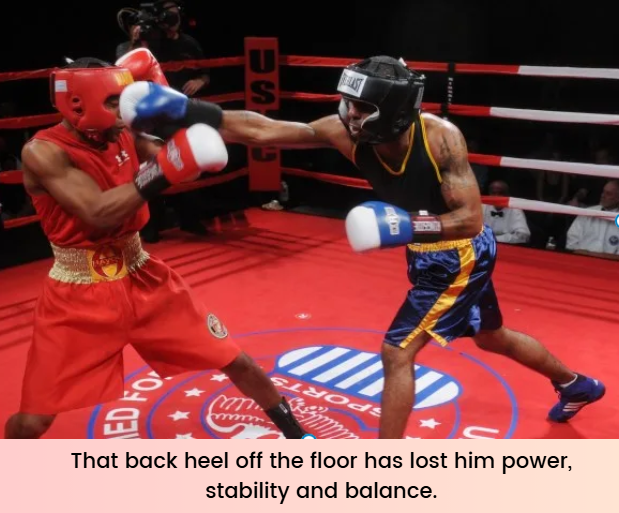
One of the most crucial elements that enables both power and speed is balance. You need to be balanced throughout the movement from the starting position to the end of the follow through. Maintaining balance is one of the fundamental basics of punching.
Never forget that only when you are balanced are you in full control of your body. Any time you are out of balance, even slightly then tension will occur to prevent you from falling over. This tension is not under your conscious control so you have no idea which muscles will tense up or how much they will tense. This automatic tension that happens when you are out of balance will certainly prevent full and efficient movement of any kind. Any movement you do while out of balance will be a compromise between what you want to do and what your body needs to do to prevent a fall.
Form your fist
A common beginners mistake is to clench their fist as tightly as possible when striking. When you clench your fist it causes tension that goes up the arm into the shoulder across the chest and so on. Try it now. Clench your fist really hard and you will feel how the muscles of the arm, shoulder and chest tighten. All this tension will act as a big brake on your punch making it slow, weak and cumbersome.
Try it now. Clench your fist really hard and you will feel how the muscles of the arm, shoulder and chest tighten. All this tension will act as a big brake on your punch making it slow, weak and cumbersome.
To form an effective fist simply close your fingers in loosely towards your palm and place your thumb between the first and second knuckles of your index finger. If you place your fist up to your eye you should be able to see right through it. You may think this fist would collapse and break on impact but you’d be very wrong. It is a structurally sound fist. Try it and see. Hit yourself a few times with a tightly closed fist then with the one I’ve described above and feel the difference. I always encourage experimentation. Don’t take what I or anyone else tells you on face value. Experiment for yourself and find out what really works.

A tightly clenched fist is often, but wrongly, believed to be more effective than a loose one.
A final word on fist formation – make sure the back of your hand and your forearm are in line with each other. If they aren’t the force of the punch will go into your wrist and can easily damage it.
Start At The End
When beginners first learn to punch it is common that the punches are quite wild and the upper body follows the fist forward towards the target while the feet remain on the floor. This means they end up leaning forward towards their target and so are off balance. Part of the reason for this is that the arm is attached to the torso near the top so it’s too easy to bend forward from the waist and follow your fist forward. This is why, in kung fu we always say to move from the centre of the body instead of the top.


The end position of the dragon punch. Practice standing in this position before you practice the punch itself.
To prevent over reaching while punching I always get my students to start from the position they’re going to end up in and work backwards from there. That way they are moving towards a balanced and familiar posture and aren’t tempted to keep moving beyond it.
A good example of a power punch is the dragon punch. This will usually end up in the dragon stance so start off in this stance and remember you will be punching with the opposite arm to your front leg. So start from that position and then pull back slightly with stance and punching arm then move forward back to that dragon stance with extended arm. Keep doing this gradually pulling back further until you can punch into that dragon stance without over-reaching.
You can do the same with many other skills. Start at the point where force will be applied and make sure you are balanced and stable at that point and then get used to moving into that position.
Coordinate Your Body
When practicing any technique try to feel which parts of the body are moving together and coordinate them as closely as you can. In this instance the back knee and the elbow of the punching arm work together. They both bend together and straighten together. When one of them is fully straight the other should also be fully straight and you should stop moving. To try to move beyond this point would mean you’re leaning forward which makes you very vulnerable.
There is a classic tai chi saying which says the feet move with the hands, the elbows with the knees and the shoulders with the hips. In any movement try to feel how these parts of your body work together and focus on keeping them coordinated.
Relax Down
Gaining and maintaining a good root at the point of impact is the most important point of gaining a powerful punch. When you make contact with an opponent a force will build up between your fist and the target. That force has to go somewhere and it will always take the path of least resistance. This means that it will go into whichever of you is the least stable. It has nothing to do with muscle power but with stability (or at least in my experience and testing on hundreds of students it’s around 30% muscle power and 70% proper alignments and stability)
I can throw around and punch down men who have twice my muscle mass with no effort at all because I know how to align my body correctly to the forces at play and they don’t. So practice your stances and learn to move and punch with relaxed power.