Many people turn up to my classes worrying that they won’t be fit enough or flexible enough. Within a very short space of time they realise those things don’t really matter. The biggest problem they have, that everyone has, is with coordination.
Coordination means getting your arms and legs to do what you want them to do.
Almost every movement I teach is a whole body movement. That means you have to move different parts of your body in different directions and in different ways at exactly the same time.
This is a real challenge for your brain as it has to coordinate over 600 muscles and work out how far to move each joint, with how much power and how to stabilise the parts that aren’t moving. That’s an awful lot of maths going on in in the background.
Luckily we are good at quickly learning new movement skills. Within anything from a few minutes to a week or so we will have learned the basics of the new movement and stored it in memory. Then it’s a question of continuous practice to refine the movement to make it more efficient by strengthening the muscles required to do it and learning to relax the muscles that aren’t needed.
When you set your mind a problem it continues to work on it in the background until it finds a solution.
If you’re struggling to learn a new movement go away and do something else for a while. Or sleep on it. Your brain will still be working on how to do it and when you come back to it you may find you get the hang of it quickly.
The five points
To make coordinating your body easier we learn to focus on our five peripheral points. These are your two hands, your two feet and your head.
Keeping track of the five points of awareness is a quick way to increase your balance and coordination skills.
Maintaining awareness of where these points are in space and how they relate to each other is a great habit to get into. It won’t take long before it becomes instinctive.
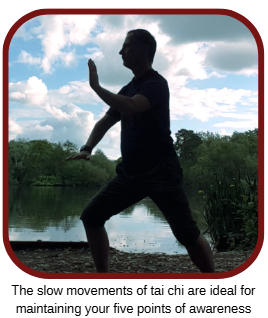
Whatever activity you’re involved in be it swinging a golf club, taking the dog for a walk or doing the washing up pay attention to the relationship between your feet, hands and head. You will instantly feel more in control of yourself, more rooted and the activity will become more efficient and more enjoyable.
The five points of awareness help with more than just coordination. They teach you to lead your awareness and energy out to your extremities. The power comes from the centre of your body and flows out from their. We learn to keep those extremities soft so the power can flow through them and out. And yes that does include your head.
Tension in your body means you’re holding onto energy there instead of letting it flow out. Anxiety in your head means the same thing. Energy is locked up in there and not being allowed to flow out or sink down. Remember, where your attention goes so energy flows.
The five points in combat
In combat knowledge of your five points of awareness could save your life. All too often I do a move on a student like a simple wrist lock and they just focus on the pain in their locked wrist. They completely forget that they have another arm which is usually hanging, unnoticed by their side. They also forget about their feet. Once this is brought to their attention they regain control of their body and can quickly see how to counter the lock.
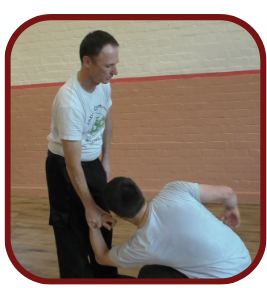
A student with locked wrist forgetting to use his other arm
I believe in general people’s coordination is so poor because they spend so little time mentally inhabiting their body. People who are more mentally aware of their body are more in the present and are said to have presence.
Make it a new habit to pay attention from time to time to the relationship between your feet, hands and head. It will pay dividends in many unexpected ways.