The world is full of competing forces – work pressures, family life, desires to conform yet stand out – yins and yangs that pull us this way and that.
These create energy, and often turmoil in our lives. Taoists have spent many centuries exploring the interplay of forces, the yin and yang throughout human life and nature and they always strive to find the middle path.
Only through finding equilibrium can they be sure that they don’t lose balance and end up being pulled off course in their following of the Tao.
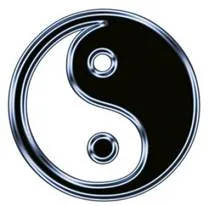
The forces of yin and yang constantly change the world around us and pull us off balance
Balance needs to be found in all three aspects of your life – physical, mental and emotional.
An imbalance in any one of these will affect the balance of the others.
For example, try to work out the 16 times table while standing on one leg or while in the grip of a strong emotion.
When faced with severe anger or fear it is hard to think clearly and also hard to coordinate your body effectively as any martial artist can tell you.
The loss of balance in one area leads to deterioration in other areas.
When a weight is picked up it will unbalance you unless compensating muscular tension builds up in the muscles on the other side of your body.
Similarly when a problem is preying on your mind it is like a weight has been applied and your mind will try to perceive a way to counterbalance that weight.
Only when it has found a way to balance the forces involved and return to a state of equilibrium can your body, mind and emotions relax.
True relaxation is only possible when mind, body and emotions are all in a state of balance.
The ‘uncarved block’
The Taoist answer to this is the concept of p’u often referred to as ‘the uncarved block’.
P’u refers to something that is in its natural, simple, unchanged state.
The original Chinese symbol refers to a tree within a wood ie one that is in its natural environment, has not been cut down and carved by someone into an image of their making.
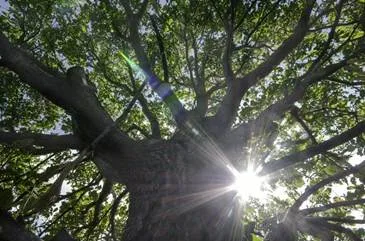

A tree in its natural state is completely at one within its environment
As with all Chinese concepts this can be read on many levels.
It recognises that each of us has to some degree been influenced or ‘shaped’ by others.
Many people feel the need to live their lives according to how others think they should be lived.
We aim to not disappoint our parents, to live up to the ideals of our partners and to stay one step ahead of the Joneses.
P’u says we should do none of these things but stay true to our own nature yet be highly sensitive of and adaptable to our environment.
However, it can be a moot point as to whether going along with your parent’s wishes could be seen as being sensitive of their wishes and adaptable or as being ‘carved’ by them into a likeness of themselves.
The answer here for me lies in whether you remain ‘carved’ when they aren’t around or whether you return to your ‘uncarved’ state.
This is really what p’u is all about. It is bending like a tree to the wind but then springing back again into its usual undistorted shape.
P’u also recognises and reinforces simplicity and naturalness in other people and other things.
The p’u concept suggests it is best not to ‘carve’ others but to leave them in their natural state.
This is why Daoists don’t try to impose their philosophies or will on others. You have your path and I have mine. I cannot change you but through my own actions (or inactions) I may inspire you to wish to change yourself.
P’u extends to all things – in diet, we should aim to preserve our food in as natural a state as possible with minimum processing and cooking.
In relationships we should aim, not to change our partner into what we believe they should be like, but to help them to find themselves, to be aware of their changing moods and conditions and be responsive and adaptable to them.
P’u is also related to conservation of energy.
As long as mind, body and emotions are kept in balance then it requires almost no energy to maintain them that way.
However, when things get out of balance then much more energy is required to return them to balance.
This ties in with one of the most crucial laws of the universe – the second law of thermodynamics. This states that everything in the universe is moving towards entropy and decay and to delay the entropy requires an input of energy.
Often an outside event will push you physically, mentally or emotionally out of balance and you will stay that way at least until the situation is resolved.
With a more traumatic event you could remain out of balance far, far longer.
The more your body remains out of balance by a particular situation then the more your block is being carved by that situation.
The carving can become so deep that it becomes permanent. The only way to prevent this happening is to learn to maintain the state of p’u in yourself.
Being p’u
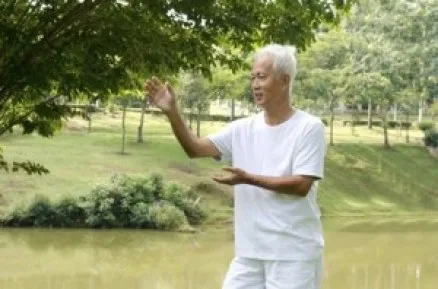
Tai chi practice helps to develop and maintain balance and p’u inside you
In order to attain and maintain p’u within yourself you must strive to be ‘in the moment’ and alive to what is going on both around you and inside you.
In this way you become more quickly and more accurately aware of changing conditions and can feel how they are affecting you.
As you start to gain more self awareness and self control you will then be able to adapt as necessary to changing winds. Adapting, yet not allowing yourself to be pulled off balance physically, mentally or emotionally.
If you were to feel yourself losing your temper for example, you would quickly become aware of it and how specifically it was happening within you (changes in breathing, muscle tension and so on) and take measures to calm down, release the excess tension and return your breathing rhythms to the state of relaxed alertness that we know as p’u.
As you would expect this can take a long time to develop but it is one of the main aims of Taoism.
Many practices, particularly breathing exercises and meditative practices have been developed to help Taoists achieve this state.
The end result is to become a person who is true to their nature and is not affected by the turmoil that may be going on around them.
In an increasingly frantic twenty first century world where lack of balance occurs in all areas of life from diet to working practices these ancient exercises and philosophies have never been more needed.
Find out more about traditional Chinese philosophies and exercises to develop a relaxed and powerful body and a focused mind through the tai chi and kung fu classes I run or sign up to our site to learn the wealth of material we have here.