The basic stance is a way of standing that keeps your body aligned with gravity, improves your posture and promotes relaxation.
For most people, the way they stand is unbalanced. Tension in the muscles pulls their body in different directions 24 hours a day. Relearning how to stand has so many benefits considering what a simple change it can be.
- Stand more securely on stronger legs
- Take the stress off your knee and hip joints
- Let go of tension in the neck and shoulder area
- Feel more stable, more rooted and more alive
- Helps to stay calm even while under stress

This is the stance we take before we begin any series of movements or exercises. It means you always start from a position of relaxed balance. Usually when people begin exercising they are starting from a stressed and unbalanced position.
When your body is unbalanced and you apply any kind of force to it it’s impossible to predict how that force will affect you
Basic Stance
The basic stance in tai chi is known as wuji. Wuji refers to a state of perfect balance. Yet when anything in the universe is in perfect balance there cannot be any movement for that would require an imbalance somewhere.
Taoists believe the entire universe was in a state of wuji for an eternity. No imbalance, no movement, no energy and thus no life. Then somehow the universe split into two complementary forces known as yin and yang. The opening movement of the tai chi form reflects that moment of universal beginning.
So before we start moving we learn to stand in perfect harmony and balance.
By always starting your movements and exercises from the same balanced, relaxed stance you have far more control over your body.
You learn what it feels like to be balanced and relaxed and return to that state as often as possible during exercise and during your daily activities. In this way you conserve energy, avoid injuring yourself and maintain a state of calm alertness as you go about your day.
Notes
- Both feet are facing forward so that you can turn at the waist and hips easily. If your feet are even slightly out to the side it limits how far you can twist your body and puts strain through your knees.
- Keeping your knees slightly bent strengthens your legs. It also teaches you to use your muscles to support the body rather than the weight going through the delicate joints. You never see a cat straighten its legs. It instinctively knows that its muscles are to be used as shock absorbers as well as for movement.
- Keeping your body upright ensures your weight is fully supported by your legs. It’s impossible to relax fully unless you are aligned with gravity. If you lean forward, even slightly there has to be tension all up the back of your body to prevent you falling forwards. By being upright you can gradually learn to relax down onto your increasingly strong legs. Your muscles will soften and relax down around your skeleton.
- Most people hold a lot of tension in their shoulders and need to be aware of it so they can consciously relax them down. Keeping your arms heavy helps to do this.
- Dropping the tailbone (sacrum) down helps connect your upper body onto your legs. It takes strain off your lower back and makes your stance much more stable.
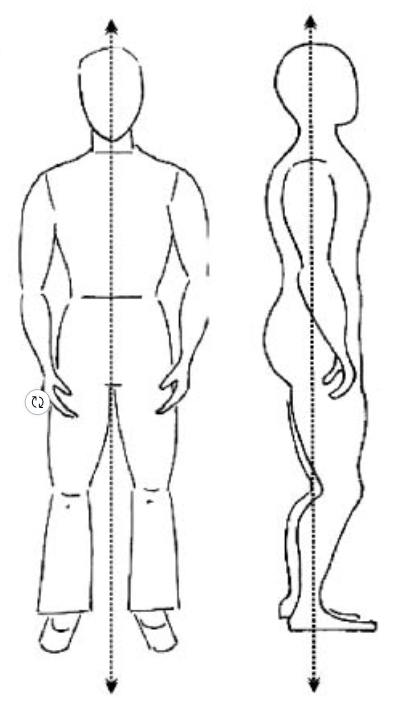
Here are the teaching points for the basic stance
- Stand with your feet shoulder width apart and both feet facing forward
- Bend your knees, or at least soften them
- Keep your body upright. Imagine all your weight dropping from the top of your head down through your feet deep into the ground
- Relax your shoulders down, then elbows, then wrists finally fingers. This will help draw your shoulders down.
- Relax your sacrum (tailbone) down, then your knees then allow your feet to soften and sink into the ground.